PCMB
Explore a Science combination with Biology, alongside Physics, Chemistry and Mathematics.
 GITAMPU COLLEGEAdmission enquiry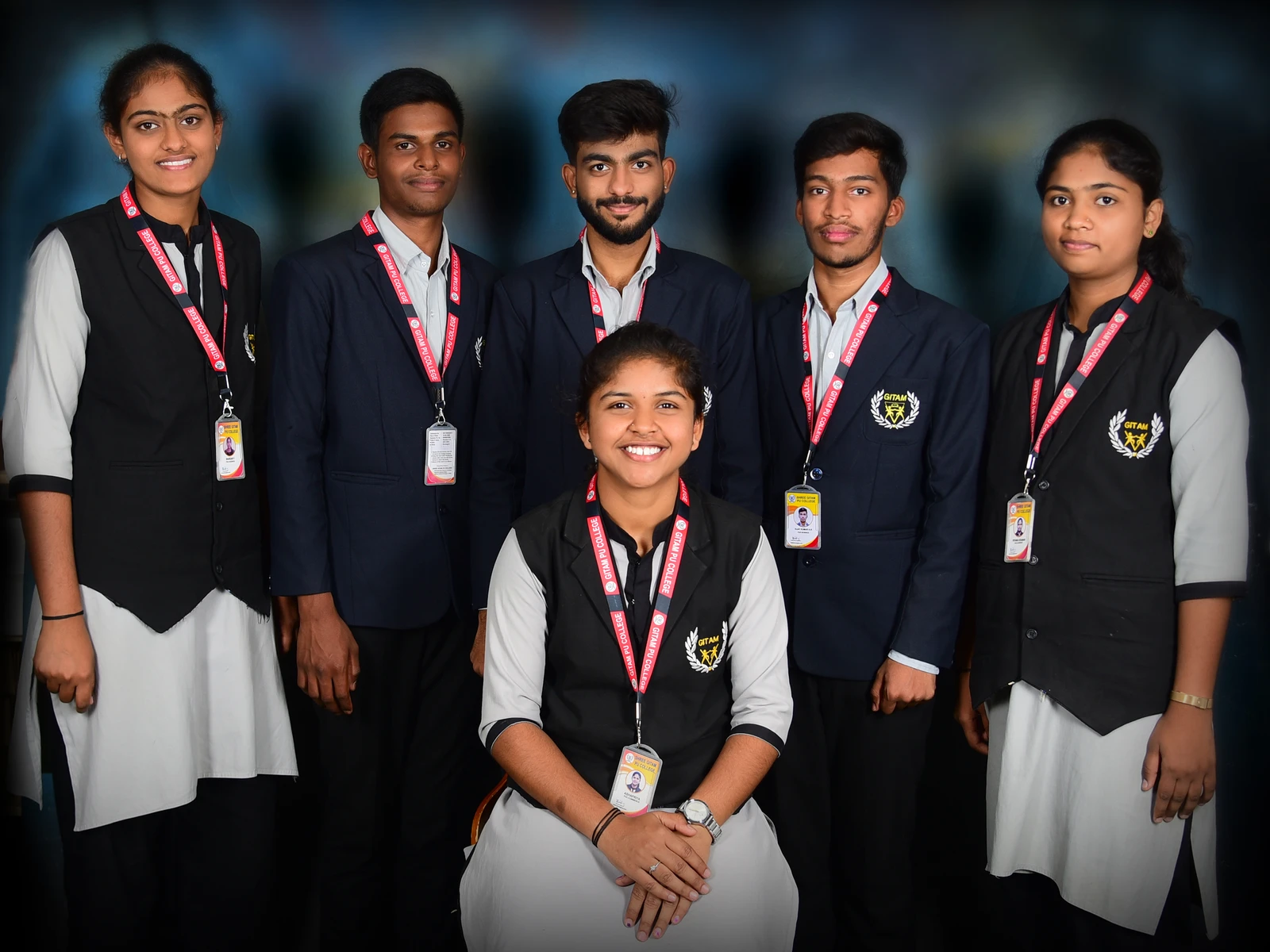
A new chapter. A world of possibility.
Discover your direction in Science and Commerce.
Build your next chapter at GITAM PU College, Davanagere.

Imagine what comes next
Every future begins with a strong foundation. Explore your pre-university choices at GITAM and take the next step towards your aspirations.
Discuss your pathwayExplore your possibilities
Start with the subjects that inspire you. Explore our Science and Commerce pathways and take the next step with guidance from our admissions team.
Explore a Science combination with Biology, alongside Physics, Chemistry and Mathematics.
Bring a curiosity for computing into your pre-university Science journey.
Discover a Science pathway for students interested in electronics and technology.
Explore the world of commerce and discuss available subject combinations with our team.
Course explorer
Select an interest to see a pathway to discuss with a counsellor.
Welcome to GITAM PU College
The pre-university years are a time to ask questions, discover your strengths and choose a direction. At GITAM PU College in Davanagere, that journey starts with Science and Commerce.
We believe in building subject understanding, confidence and a sense of purpose—helping students move towards the next stage of their education.
Get to know GITAMBuild knowledge through curiosity, consistency and academic focus.
Speak with our team about your interests and pre-university choices.
Your next step
Choosing a college is a conversation. Tell us what you’re looking for, and let’s explore your options together.
Start your enquiryCompare PCMB, PCMC, PCME and Commerce to find subjects that interest you.
Use the application form or call us to discuss courses, eligibility, fees and required documents.
Confirm the current admission process and next steps directly with the college.
Connected to your college
Students
Visit student resources and explore guidance for the next stage of your education.
Student cornerParents
Stay connected to your child’s college journey and find the parent resources.
Parent cornerBeyond the classroom
Explore college events, updates and moments from the GITAM community.
Events & activitiesGood questions. Clear next steps.
Our pre-university pathways include PCMB, PCMC, PCME and Commerce. The admissions team can explain the available subjects and help you compare options.
Open the admission enquiry form or call +91 96066 91888 or +91 96066 92888. Our team can guide you through the current process and documents required.
Please contact the college directly for current fees, eligibility, availability and dates. An enquiry does not confirm or guarantee admission.
Our published contact address is New Banashree Layout, Shamanur, Davanagere 577004, Karnataka. Call the college before your visit for directions and the appropriate admission office.
Yes. Parents and students can reach us on either admissions number or email shreegitam@gmail.com to discuss their questions.
We’re here to help
New Banashree Layout, Shamanur, Davanagere 577004

Schools & Pre-university college
Your ambition. Our commitment. Explore Science and Commerce pathways in Davanagere.
Stay Updated with Our Newsletter
Explore PCMB, PCMC, PCME and Commerce. Speak with our admissions team about the pathway that suits your interests and goals.
Start with an admission enquiry. Our team can guide you through course choices, required documents and the next steps.
Build subject understanding and confidence with faculty guidance throughout your pre-university journey.
A BSC (Biomedical Science) Catch Lab Tech refers to a laboratory technician who works in the field of biomedical sciences, particularly in research, diagnostics, and laboratory testing. The job typically involves assisting with a wide range of laboratory procedures, conducting experiments, and performing tests that support medical diagnoses, research initiatives, or product development.
Here’s a more detailed view of the role:
Sample Collection & Preparation: The technician collects biological samples such as blood, urine, or tissue from patients or subjects for analysis.
Laboratory Analysis: Conduct tests and experiments on biological samples to detect, diagnose, or monitor diseases. This may include using techniques such as PCR (Polymerase Chain Reaction), microscopy, blood cultures, and other biochemical tests.
Equipment Maintenance: Operate, calibrate, and maintain laboratory instruments, ensuring they work efficiently and safely.
Data Recording: Maintain detailed and accurate records of experimental results, patient data, and procedures performed.
Quality Control: Ensure that lab tests are conducted under controlled, sterile, and standardized conditions, adhering to regulatory guidelines.
Safety Protocols: Follow proper safety protocols to avoid contamination, exposure to hazardous materials, or accidents.
Technical Proficiency: Understanding and proficiency with laboratory instruments such as centrifuges, microscopes, incubators, and automated diagnostic systems.
Analytical Thinking: Ability to interpret experimental results, troubleshoot issues, and adjust methods based on findings.
Attention to Detail: Accuracy in carrying out tests, ensuring quality control and consistent results.
Communication Skills: Clear communication for reporting results, collaborating with other laboratory staff, and interacting with healthcare professionals.
Diagnostic Assays: Techniques such as ELISA, PCR, and flow cytometry for disease diagnosis and research.
Microscopy: Light microscopy or electron microscopy for observing samples at a cellular or tissue level.
Cell Culture Techniques: Growing cells in controlled conditions for experiments or diagnostics.
Automation Tools: Use of automated lab equipment for high-throughput testing and data analysis.
Degree: Typically, a Bachelor of Science (BSc) in Biomedical Science or a related field is required. Some labs may also hire candidates with certifications in medical laboratory technology or clinical laboratory science.
Advanced Training: Depending on the lab’s focus, additional certifications or training may be required (e.g., clinical pathology certifications).
Labs: The technician works primarily in laboratory settings, which may be within hospitals, research institutes, pharmaceutical companies, or universities.
Hours: Some positions may require shift work, especially if the lab provides 24/7 diagnostic services.
Team Collaboration: The technician usually works alongside scientists, medical doctors, other lab technicians, and researchers to support various clinical or research projects.
Clinical Labs: Performing tests related to patient care, including blood tests, urine analysis, and diagnostic procedures.
Research Labs: Supporting biomedical research, often involved in experiments related to disease processes, genetics, or drug development.
Public Health Labs: Assisting in epidemiological studies, such as tracking the spread of infectious diseases or studying environmental health.
Further Study: There is potential for further education or specialization, leading to roles such as a Senior Lab Technician, Laboratory Manager, or Clinical Laboratory Scientist.
Professional Certifications: Additional certifications (e.g., ASCP or CLT) can enhance career prospects, particularly for roles in clinical diagnostics or medical laboratories.
Workload: The role can be demanding, especially in high-volume labs, with pressure to produce accurate results under tight deadlines.
Health and Safety: Working with biological specimens, chemicals, and other potentially hazardous materials requires strict adherence to safety protocols to minimize risk.
Continuous Learning: As biomedical science evolves, lab technicians must stay updated with new diagnostic techniques, equipment, and safety regulations.